
Cangjie Skill
Distill methodologies from books, long-form videos, and podcasts into callable AI Skills





Finish reading, watching, or listening—and leave with a methodology you can invoke.
Official Website
🌐 Visit the Cangjie Skill official website
The website provides visual Skill Pack browsing, a beginner-friendly usage guide, Skill detail pages, and a contribution submission entry. This GitHub repository remains the sole source for cangjie-skill code, methodology, and templates; the website provides presentation, navigation, and usage guidance.
DeepSeek Harness Plugin
cangjie-skill also provides a standalone installation package for DeepSeek Harness. The adapter layer is bundled in the Release package, so no platform-specific wrapper files are added to this repository.
After installing DeepSeek Harness, run:
mkdir -p ~/.dsh/packages
curl -fL "https://github.com/kangarooking/cangjie-skill/releases/download/v2.0.0/dsh-cangjie-skill-2.0.0.tgz" \
  -o ~/.dsh/packages/dsh-cangjie-skill-2.0.0.tgz
dsh plugin --profile web add ~/.dsh/packages/dsh-cangjie-skill-2.0.0.tgz
dsh web
Download the DeepSeek Harness plugin (for Cangjie Skill v2.0.0)
After starting a new task, you can say:
Use cangjie-skill to distill this book into a set of executable Agent Skills: <file path>
Why This Exists
There's a recent viral idea: distilling colleagues into AI skills. Even after someone leaves, their experience, tone, and work style can be partially replicated by AI. nuwa-skill does exactly this — creating "human skills" like an Elon Musk skill or a Warren Buffett skill. The companion darwin-skill handles automatic skill evolution.
Distilling people is valuable — nuwa-skill has already proven this. Distilling the content people have expressed systematically is a complementary dimension: a book, a long-form interview, a podcast episode, or a long Bilibili or YouTube video can contain methodologies that took the creator years to refine. Rather than imitating someone's expression style, extracting those methodologies and turning them into tools that solve real problems is equally valuable.
There's also a real pain point: you may read many books, save many videos, and listen to many podcasts, yet still struggle to apply what you learned. Content-rich long videos are published every day, are often time-sensitive, and can be difficult to absorb in one viewing; they may not be represented in an AI model's training data at all. Once this content is distilled into skills, an AI agent can invoke the knowledge in real scenarios instead of letting it gather dust in notes, bookmarks, or watch-later lists.
So cangjie-skill has one clear goal: distill every piece of high-value content worth distilling. It works not only with books, but also with videos that have subtitles or transcripts, podcasts, interviews, talks, courses, long-form articles, and document collections. Whenever content contains extractable, verifiable, and transferable methodologies, cangjie-skill can turn them into independently callable, composable, and pressure-testable AI skill packs.
For video content, we recommend using the video-downloader skill alongside cangjie-skill. Use it first to download the video, extract subtitles or audio transcripts, and collect key materials; then pass the resulting text to cangjie-skill for methodology extraction, skill construction, and pressure testing.
What Problems It Solves
- Reading many books, watching many videos, or listening to many podcasts without applying them — knowledge stays at the "read/watched/listened/saved" level and cannot be invoked in real decisions
- Summaries, notes, and organized transcripts are compression, not structured reuse — after reading or watching, you still do not know "what to use when"
- Only a small fraction of high-value content deserves to become a tool — strict filtering is needed, not wholesale inclusion
- Existing methods for reading, watching, and learning are designed for people, not agents — distillation must be execution-oriented rather than consumption-oriented
How It Works
cangjie-skill uses the RIA-TV++ pipeline to transform source texts—including books, video transcripts, podcast transcripts, and interview notes—into a set of structured skills. The process has seven stages:
- Whole-Content Comprehension (Adler Analysis) — Structural, interpretive, critical, and applicability analysis using Mortimer Adler's method, producing
BOOK_OVERVIEW.md - Parallel Extraction — Five specialized extractors (frameworks, principles, cases, counter-examples, glossary) run simultaneously to pull candidate units from the source text
- Triple Verification — Each candidate must pass three checks: at least 2 independent supporting passages (cross-domain), ability to answer a novel question (predictive power), and non-commonsense uniqueness. Pass rate is typically 25-50%
- RIA++ Construction — Verified content is structured into six dimensions: R (original quote) / I (own-words reconstruction) / A1 (book cases) / A2 (future trigger scenarios) / E (executable steps) / B (boundaries & blind spots)
- Zettelkasten Linking — Dependency, contrast, and composition relationships between skills are identified, producing
INDEX.mdwith a reference graph - Pressure Testing — Test prompts including bait questions (and cross-skill confusion tests) are designed for each skill; failures go back for full reconstruction
- Delivery — A reader-facing
DIGEST.mdlong-form digest is generated (skip the book, read the essence), and tested skills are installed into the Claude Code / Cursor skills directory so they can actually be invoked
The name RIA-TV++ breaks down as:
- RIA: From Zhao Zhou's bookmark method (Reading / Interpretation / Appropriation)
- TV: Triple Verification
- ++: Agent-oriented extensions — E (Execution) + B (Boundary)
Effect Examples
Example 1: From a Book or Long-Form Video to a Skill Toolkit
User Need
"I want to turn the core methodologies from a book or a long Bilibili/YouTube video into reusable AI skills, not just a summary."
How cangjie-skill reasons
- Check whether the source material has reusable methodological units
- Distinguish what deserves to be a standalone skill vs. background material
- Output a structured skill repository, not a single summary document
Example Output
The result will not be one summary document. It will be a multi-skill repository with
BOOK_OVERVIEW.md,INDEX.md, a reader-facingDIGEST.md, aGLOSSARY.md, multiple*/SKILL.mdfiles, andtest-prompts.jsonfor trigger testing.
Example 2: Structured Reuse, Not Compression
User Need
"I don't want a long explanatory article. I want a skill pack my agent can reuse."
How cangjie-skill reasons
- Target is structured reuse, not narrative compression
- Prioritize triggerable, composable, testable skill units
- Reject material that doesn't deserve standalone skill status
Example Output
The system produces multiple skill modules with trigger conditions, boundaries, execution patterns, and related-skill links — rather than flattening the source into one generalized note.
Generated Skill Packs
| Repository | Source | Skills |
|---|---|---|
| buffett-letters-skill | Buffett's shareholder letters (1957-2023) | 20 |
| cognitive-dividend-skill | Cognitive Dividend | 15 |
| duan-yongping-skill | Duan Yongping's Q&A (business + investment logic) | 15 |
| viral-copywriting-skill | Bao Kuan Wen An | 14 |
| copywriters-handbook-skill | The Copywriter's Handbook | 12 |
| contagious-skill | Contagious | 15 |
| influence-skill | Influence | 12 |
| 1000-true-fans-skill | 1000 True Fans | 13 |
| system-prompt-skills | 165 AI product system prompts | 15 |
| X-growth-skills | Practical X (Twitter) account launch, content growth, algorithm, engagement, and monetization resources | 15 |
| poor-charlies-almanack-skill | Poor Charlie's Almanack | 12 |
| no-rules-rules-skill | No Rules Rules | 10 |
| huangdi-neijing-skill | Huangdi Neijing (Suwen + Lingshu) | 22 |
| first-principles-skill | First Principles | 10 |
| mao-selected-works-skill | Selected Works of Mao Zedong, Vol. 1-5 | 25 |
| qbdx-hub/buffett-letters-skill | Buffett Shareholder Letters (1957-2023) | 20 |
| qbdx-hub/wo-yu-di-tan-skill | Wo Yu Di Tan | 6 |
| qbdx-hub/mingchao-those-things-skill | Mingchao Those Things | 7 |
| qbdx-hub/sunzi-bingfa-skill | Sunzi Bingfa | 8 |
| qbdx-hub/zhouyi-skill | Zhouyi | 8 |
| qbdx-hub/high-math-vol1-ch1-skill | High Math Vol. 1 Chapter 1 | 8 |
Video Distillation
These repositories are built from subtitles or transcripts of long-form videos, courses, or video collections. They demonstrate cangjie-skill's ability to distill methodologies from non-book content.
| Repository | Source | Skills |
|---|---|---|
| ai-for-everyone-skill | Andrew Ng's AI for Everyone video course | 25 |
| loop-engineering-skill | Loop Engineering long-form video collection | 8 |
More high-value books are planned for distillation. Future candidates include, but are not limited to, The Prince.
Additional external source (included with the author's permission):
- Source repository: ace3000chao/book2startup
- Included books: The Lean Startup, The Art of War, Zhuangzi, and I Ching
- Source repository: shenqistart/book2skill
- Included books: Chanlun and The Classic of Tea
Repository Structure
cangjie-skill/
├── README.md              ← You are here (default)
├── README.zh-CN.md        ← Simplified Chinese version
├── README.ja.md           ← Japanese version
├── LICENSE                ← MIT License
├── SKILL.md               ← Meta-skill definition (full execution spec for cangjie-skill)
├── methodology/           ← RIA-TV++ stage-by-stage methodology docs
├── extractors/            ← Prompt definitions for the 5 parallel extractors
└── templates/             ← SKILL.md / INDEX.md / BOOK_OVERVIEW.md templates
Ecosystem
cangjie-skill is part of a larger skill ecosystem:
- nuwa-skill — Distills people (thinking styles, expression DNA)
- cangjie-skill (this repo) — Distills books (methodologies, frameworks, principles)
- darwin-skill — Evolves any skill
They interlock: nuwa distills people, cangjie distills books, darwin keeps them evolving.
More Skills
- Buffett Letters Skill — 20 investment reasoning skills from Buffett's 60+ years of shareholder letters
- Poor Charlie's Almanack Skill — 12 decision-making and judgment skills from Charlie Munger's core thinking methods
- No Rules Rules Skill — 10 organizational design skills from Netflix's culture of freedom and responsibility
- Cognitive Dividend Skill — 15 cognitive tool skills for thinking upgrades from Cognitive Dividend
- Duan Yongping Skill — 15 business and investment skills from Duan Yongping's Q&A collection
- Viral Copywriting Skill — 14 sales copywriting and diagnosis skills from Bao Kuan Wen An
- Copywriters Handbook Skill — 12 sales copywriting, headline, and benefit translation skills from The Copywriter's Handbook
- Contagious Skill — 15 STEPPS propagation strategy and word-of-mouth diagnosis skills from Contagious
- Influence Skill — 12 persuasion psychology, compliance mechanism, and defensive judgment skills from Influence
- 1000 True Fans Skill — 13 personal branding, true fan development, and trust-based monetization skills from 1000 True Fans
- System Prompt Skills — 15 system prompt design skills distilled from 165 AI product system prompts
- X Growth Skills — 15 skills for X account launch, content, algorithms, engagement, review, and monetization
- Huangdi Neijing Skill — 22 methodology skills from Huangdi Neijing, including 12 from Suwen and 10 from Lingshu
- First Principles Skill — 10 skills on axiomatic reasoning, boundary-breaking innovation, and organizational refresh from First Principles
- Mao Selected Works Skill — 25 cognition, strategy, organization, and execution skills from Selected Works of Mao Zedong
- qbdx-hub Buffett Letters Skill — 20 investment and capital allocation skills from Buffett shareholder letters
- qbdx-hub Wo Yu Di Tan Skill — 6 skills on limits, suffering, writing, and self-anchoring from Wo Yu Di Tan
- qbdx-hub Mingchao Those Things Skill — 7 skills on power structure, institutional failure, and historical explanation from Mingchao Those Things
- qbdx-hub Sunzi Bingfa Skill — 8 skills on strategic judgment, resource control, and action selection from Sunzi Bingfa
- qbdx-hub Zhouyi Skill — 8 skills on situational diagnosis, timing, and advance-retreat boundaries from Zhouyi
- qbdx-hub High Math Vol. 1 Chapter 1 Skill — 8 learning skills on limits, infinitesimals, and continuity from High Math Vol. 1 Chapter 1
External Source (included with the author's permission):
- book2startup — includes skills distilled from The Lean Startup, The Art of War, Zhuangzi, and I Ching
- book2skill — includes AI-Agent skills distilled from Chanlun and The Classic of Tea
Contributors
Thank you to the following contributors for expanding the cangjie-skill ecosystem:
- shenqistart — contributed the external book2skill reference and additions across the Chinese, English, and Japanese READMEs
- qbdx-hub — contributed 6 Cangjie whole-book/chapter distillation example repositories and additions across the Chinese, English, and Japanese READMEs
About the Author
袋鼠帝 kangarooking — AI blogger and indie developer. Creator of the AI Top WeChat Official Account “袋鼠帝 AI 客栈”

Volcengine Navigation KOL, Baidu Qianfan Developer Ambassador, GLM Evangelist, Trae Kunming's First Fellow
| Platform | Link |
|---|---|
| 𝕏 Twitter | https://x.com/aikangarooking |
| Xiaohongshu | https://xhslink.com/m/5YejKvIDBbL |
| Douyin | https://v.douyin.com/hYpsjphuuKc |
| WeChat Official Account | 袋鼠帝 AI 客栈 |
| WeChat Video Channel | AI 袋鼠帝 |
WeChat Official Account「袋鼠帝 AI 客栈」QR code:

If you also want to distill methodologies from books, long-form videos, podcasts, and courses into callable Agent Skills, join the cangjie-skill WeCom community group:
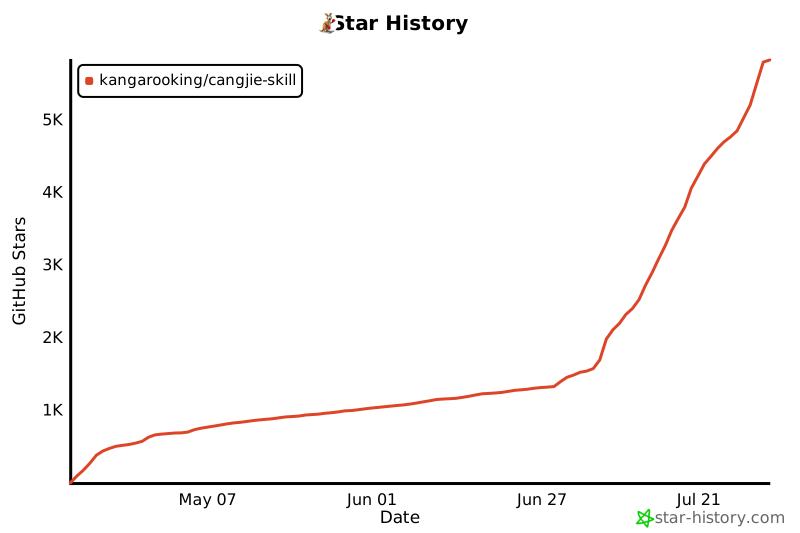
⭐ Star History
If this project has helped you, please star it.
License
MIT License. See LICENSE.